Print operations that have modernised their technology stack report 9% less waste on average, according to Alliance Insights research from PRINTING United Alliance. That's not a projection. It's what's already happening on presses right now.
The number is real, but the reason behind it surprises most people: it isn't about adding more automation. It's about connecting the automation you already have.
The Real Driver Behind the 9% Number
Around 80% of print service providers have already automated at least part of their workflow, per the same Alliance Insights data. Automation on its own is no longer the differentiator. Nearly everyone has some.
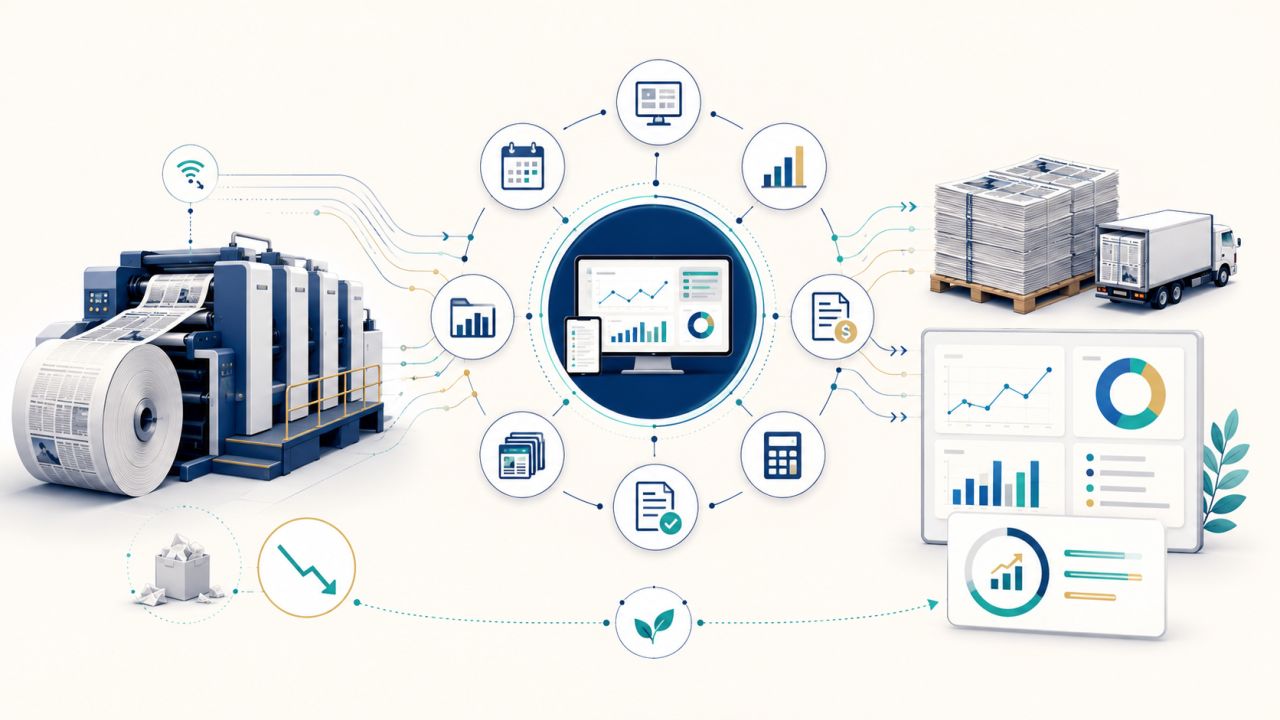
What separates the operations seeing that 9% waste reduction is what happens after automation: they link MIS, scheduling, analytics and production data into one connected ecosystem, instead of running each as its own island. Information moves between systems on its own. No exports, no manual re-entry, no reconciling three spreadsheets against what actually happened on the floor.
What "Connected" Looks Like Inside a Newspaper Print Operation
For newspaper print, a connected stack usually means three things are true at once:
- Paper consumption is tracked in real time, not reconciled at month end.
- Edition planning and press scheduling live in the same system, so a late edit doesn't mean a scramble across three tools.
- Billing, insert management and post calculation close the loop on every single run, automatically, rather than waiting on someone to key it in.
When those pieces are disconnected, waste hides in the gaps between them: in the reconciliation, in the manual handoff, in the version of the schedule that's a day out of date. Connecting them doesn't just remove steps. It removes the places waste was hiding.
Why Visibility Matters More Than Efficiency
Efficiency gets the headline, but visibility is the actual payoff. When paper consumption, scheduling and billing all report from the same source of truth, you're not just running leaner. You can see a problem forming before it costs you a run, on deadlines that don't move.
That's the difference between reacting to waste after the fact and catching it before the next edition closes.
Where Print365 Fits
This is exactly the gap Print365 is built to close. It's modular and purpose built for newspaper production, designed to connect the processes that, in most operations, still sit in separate tools, or in one person's head. Paper tracking, edition planning, press scheduling, insert management and post calculation run as one connected system rather than five disconnected ones.
FAQ
What causes waste in newspaper print production?
Most waste doesn't come from the press itself. It comes from the gaps between systems: manual reconciliation between paper consumption records and actual usage, scheduling changes that don't reach every team in real time, and billing or post calculation that happens after the run instead of alongside it.
What is a Print MIS?
A Print MIS (Print Management Information System) is software built specifically to run print production, connecting scheduling, paper and material tracking, billing and post calculation in one system. Unlike a general ERP, a Print MIS is built around the specific workflow of a press floor rather than adapted from generic manufacturing software.
How much waste can a connected print operation actually save?
According to Alliance Insights research from PRINTING United Alliance, print operations that have modernised and connected their technology stack report 9% less waste on average, driven by removing manual handoffs between MIS, scheduling, analytics and production data.