Show the full transcript (5 min)
Hi, I'm Fredrik and I work with the data platform at MWM. Everyone in print is asking the same thing right now: how do we actually use AI in our day to day? There are a lot of possibilities, and a lot nobody knows yet. This is our answer: Print365 DatAInsights. We also call it Talk to the Data.
Think about your dashboards. Someone decided what they can answer, months ago. Dashboards answer the questions someone planned for. Print365 DatAInsights answers the questions you didn't know you had.
Let's start with something you already have a report for: cost and margin, planned against actual, per customer, last quarter. Overall, cost came in 171,000 under plan. Margin is on plan, better than plan. On a dashboard, this is where most of us would stop looking.
The answer lists every customer, row by row, just like a drill down would. And there it is: Northwind Foods, 58,000 over planned cost, margin 17% below plan. But drilling only shows you more of the same numbers. It tells you who. It doesn't tell you why. Drill into the money and you only get more money. What you need is the next question.
Under every answer, Print365 DatAInsights suggests where to look next. Some suggestions change the kind of data. I tap "Cost overrun drivers". Now it puts planned and actual waste, paper and press hours next to the money. You asked a finance question. It handed you a production one. Across all customers, waste came in 31% under plan. Northwind went the other way: waste 66% over, paper 27% over, press hours 13% over. Cost data showed who. Production data showed why. The margin was lost on the press floor. That is the question you didn't know you had.
So that's what it does. Now let's look at what it takes, because an answer nobody planned for still has to be right.
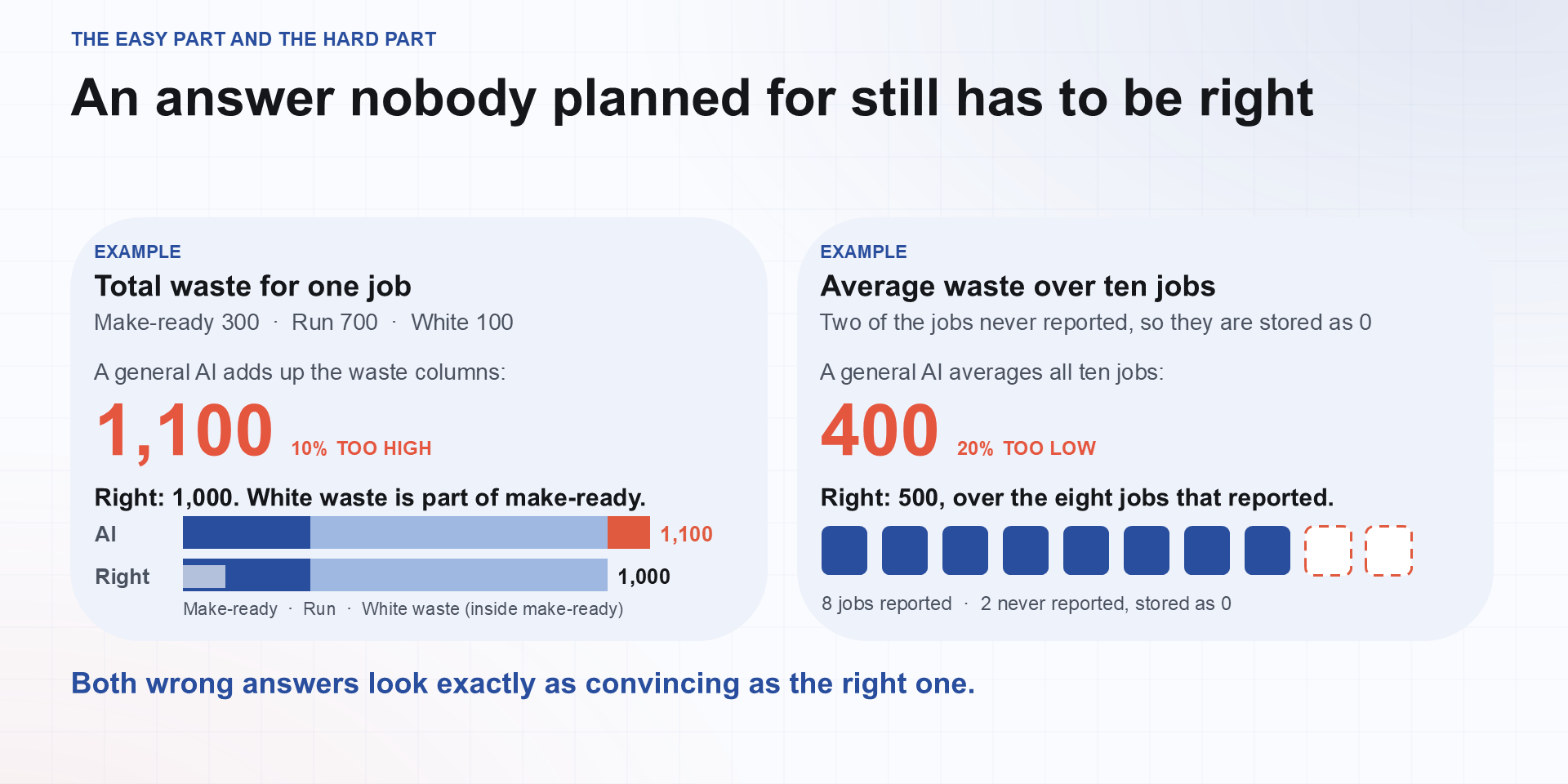
You could connect a general AI to your database in an afternoon. It would answer fast, and confidently. Take one job: 300 copies make ready waste, 700 run waste, 100 white waste. A general AI adds up the columns and says 1,100. The right answer is 1,000, because white waste is already part of make ready. Ten percent too high, with no warning. Or take the average waste over ten jobs where two never reported. They are stored as zero, so a general AI says 400. The right answer is 500. Twenty percent too low. Both wrong answers look exactly as convincing as the right one. Getting the right answer, safely, every time: that is the hard part. Here is how we solve it.
First, the AI never answers from memory. For common questions, MWM has already built and checked the building blocks: waste percentage, last week, per plant. The AI only picks which blocks fit your question. The system builds the query, checks that the query only reads, and runs it on your data. The database does the counting. The AI turns the result into an answer. If no block fits, the AI writes its own query, and it goes through the same check. You can open the query behind every answer.
Second, the AI has to understand the data, not just read it. You've seen two traps already. There are more. One product shows up under many names. Runtimes are stored in milliseconds. You know this because you work with the data every day. A general AI does not. So we write down what every column means, its unit, and what your words mean. Every column and total is checked against real data, and a change only reaches you after our test questions have run again.
Third, the question every printer asks: can someone else see my numbers? No. Every query is checked before it runs. Your company has its own login that can only read. And the database itself only returns your company's rows, whatever query arrives. That is the guarantee. None of this depends on what the AI is told. Your conversations are private to you and deleted after 30 days.
Fourth, what happens when an answer is still wrong. You tap "Report this answer". We see exactly how it was made: how the question was read, and which building blocks or query were used. We see that conversation up to that answer, and nothing else. We fix the cause and test it before it goes live. Most fixes go into the data description all customers share, so one report improves the answers for everyone. Only the fix is shared, never your data.
So, three things to take home. Start with what you know: the question you already have a report for. Follow what it shows you: what stands out, and the next question it hands you. And trust the numbers: they come from your data, nobody else sees them, and a wrong answer gets fixed for everyone. That takes knowing print data, not just an AI.
Want to see what your own data can tell you? Book a short call with us. We'll take one question you already ask today and follow it with you in Print365 DatAInsights. No sales pitch. No commitment.